Why Good Employees Stop Caring Before They Quit
Let's be honest. Nobody starts a job planning to just coast. Good people, the ones who show up ready to make a difference, they don't wake up one morning and decide to stop caring. It's not a switch that flips. It's a slow, grinding process, a quiet erosion of their commitment until they're just going through the motions. And by the time they're looking for the exit, they've usually been gone for a while.
This isn't about laziness. It's about a fundamental breakdown in the workplace, a series of mismatches that chip away at even the most dedicated individuals. When things stop making sense, people stop investing themselves. It's that simple.
The Mismatch: When the Job Stops Fitting
Burnout isn't some personal weakness; it's a symptom of a broken system. Research by Christina Maslach and Michael P. Leiter highlights six key areas where the job and the person can become fundamentally misaligned [1]. Think of these as the cracks that start to appear:
Workload: The Endless Treadmill
It starts subtly. A little extra here, a tight deadline there. Soon, the workload becomes a relentless, unsustainable pace. It's not just about hours; it's about the sheer volume of tasks, the constant pressure, and the feeling that no matter how much you do, it's never enough. This isn't about being busy; it's about being overwhelmed, consistently. When the demands outweigh the resources, something has to give.

Control: The Illusion of Autonomy
Good employees want to own their work. They want a say in how things get done, a sense of agency over their projects and their day. But when decisions are constantly made above their heads, when processes are rigid and inflexible, or when their expertise is ignored, that sense of control erodes. It's frustrating to be held accountable for outcomes you have no power to influence. This lack of autonomy breeds resentment and a feeling of powerlessness.
Reward: The Unseen Effort
People aren't just working for a paycheck. They seek recognition, appreciation, and a sense that their contributions matter. When hard work goes unnoticed, when promotions are opaque, or when compensation doesn't reflect effort or market value, it sends a clear message: your effort isn't valued here. This isn't always about money; sometimes, a simple 'thank you' or public acknowledgment can make a world of difference. When rewards are insufficient, both financially and socially, the motivation to go the extra mile vanishes.
Community: The Isolated Island
Work isn't just about tasks; it's about people. A healthy workplace fosters a sense of belonging, trust, and mutual support. But when the community breaks down—due to toxic leadership, internal competition, or a lack of genuine connection—employees feel isolated. They become wary, guarded, and less willing to collaborate or share. It's hard to care about a place where you feel like you're on your own, fighting battles in isolation.
Fairness: The Crooked Scale
Nothing sours an employee faster than a perceived lack of fairness. This can manifest in countless ways: unequal distribution of workload, biased performance reviews, favoritism in promotions, or inconsistent application of rules. When employees see others getting ahead through politics rather than merit, or when their own efforts are overlooked while less deserving colleagues are rewarded, the sense of injustice is palpable. It undermines trust and makes people question the integrity of the entire system.
Values: The Moral Compromise
At its core, this mismatch is about integrity. Good employees want to believe in what they do and who they do it for. When there's a conflict between their personal values and the organization's mission, ethics, or practices, it creates deep internal dissonance. Being asked to compromise their principles, to cut corners, or to engage in practices they don't believe in is a fast track to disengagement. It's hard to give your best when your conscience is constantly at war with your job.
Burnout: The Slow Fade to Indifference
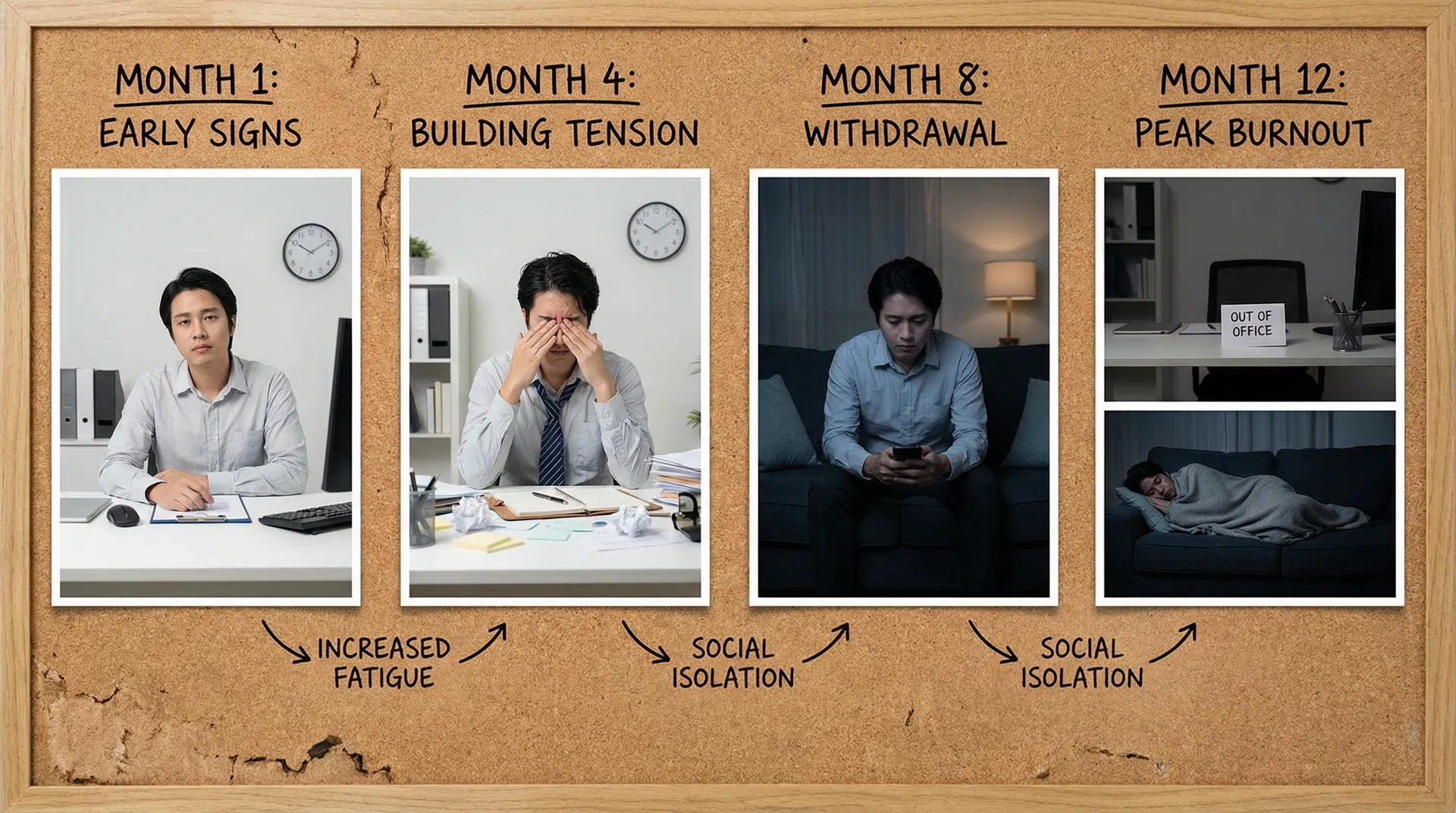
These mismatches don't just disappear. They fester, slowly transforming dedicated employees into disengaged ones. This is where burnout sets in, not as a sudden collapse, but as a gradual withdrawal. Christina Maslach identifies three core dimensions of burnout: exhaustion, cynicism, and reduced professional efficacy [1].
Exhaustion: Running on Empty
It starts with physical and emotional depletion. The constant demands, the lack of control, the feeling of being undervalued—it all takes a toll. Sleep suffers, patience wears thin, and the energy to tackle even simple tasks evaporates. This isn't just being tired; it's a profound, persistent weariness that no amount of rest seems to fix. It's the feeling of running a marathon every day, without a finish line in sight.
Cynicism: The Shield of Not Caring
As exhaustion deepens, cynicism creeps in. The idealism that once drove the employee fades. They stop believing that their work matters, that the organization cares, or that their efforts will be recognized. They develop a protective shell of indifference, a "why bother?" attitude. This isn't apathy born from laziness; it's a defense mechanism against repeated disappointment. When nothing you do seems to make a difference, it's easier to stop trying.
Reduced Professional Efficacy: The Erosion of Competence
Finally, the employee's sense of competence and effectiveness crumbles. They feel less capable, less productive, less valuable. Their confidence in their abilities deteriorates, even if their actual performance hasn't changed. They start to internalize the message that they're not good enough, that they're failing. This creates a vicious cycle: low confidence leads to lower performance, which reinforces the negative self-perception.
The Exit: When Disengagement Becomes Departure
Here's the critical insight: people don't leave all at once. Burnout builds first. Then the exit happens. By the time an employee is actively job searching or handing in their resignation, they've often been mentally checked out for months.
Stage 1: Quiet Quitting
The first sign of exit is often invisible. The employee is still showing up, still doing their job, but they're no longer going the extra mile. They're not volunteering for projects, not staying late, not bringing their full self to work. They're doing the minimum required and nothing more. This is quiet quitting—the employee hasn't left, but they've already disengaged.

Stage 2: The Job Search
As disengagement deepens, the employee starts looking for a way out. They browse job listings, update their resume, reach out to recruiters. They're still at their current job, but mentally, they're already gone. They're looking for a place where things might be different, where they might feel valued again. This stage can last weeks or months, and during this time, their performance often continues to decline.

Stage 3: The Resignation
Finally, the employee finds a new opportunity and makes the decision to leave. The resignation is often presented as a sudden departure, but it's rarely sudden. It's the culmination of months of misalignment, burnout, and disengagement. The employee walks out the door, and the organization is left wondering what went wrong. They might blame external factors—a better offer, a desire for change—but the real reason is that the job stopped working for them long ago.

The Cost of Ignoring the Pattern
From an organizational perspective, this pattern is expensive. The cost of replacing an employee—recruitment, training, lost productivity—far exceeds the cost of addressing the mismatches that led to their departure in the first place. More importantly, the departure of a good employee sends a signal to the rest of the team. If talented people are leaving, others start to wonder if they should too.
But here's what's often missed: the real cost isn't just the departure. It's the months of reduced productivity, the impact on team morale, and the loss of institutional knowledge. A disengaged employee isn't just less productive; they can actively harm team dynamics and culture.
What This Means
People don't leave because they're weak or ungrateful. They leave when things stop making sense. They leave when the mismatches between what they need and what the job provides become too great to ignore. They leave when burnout has drained them so completely that they have nothing left to give.
The exit isn't sudden. It's the final step in a long process that begins with misalignment and progresses through burnout to disengagement. And by the time the resignation letter is handed in, the employee has often been gone for a long time.
People don't leave all at once. Burnout builds first. Then the exit happens.
References
[1] Maslach, C., & Leiter, M. P. (2016). Understanding the burnout experience: recent research and its implications for psychiatry. World Psychiatry, 15(2), 103–111. https://pmc.ncbi.nlm.nih.gov/articles/PMC4911781/
[2] Gallup. (2023). State of the Global Workplace 2023 Report. Retrieved from https://www.gallup.com/workplace/349484/state-of-the-global-workplace.aspx